News   Apr 03, 2020
 9.1K     3 
News   Apr 02, 2020
 10K     0 
News   Apr 02, 2020
 3.3K     0 

General Infill Discussion

Affordable housing providers selected for 10 former surplus school sites
November 24, 2024

The City has selected affordable housing providers for 10 former surplus school sites, a major milestone in the effort to create more than 900 homes for Edmontonians in need.

“I am thrilled that we are one step closer to making this vision a reality. Too many Edmontonians are struggling to get by and can’t find the housing they need. Providing land to affordable housing providers is the best tool we have as a city to respond. These are not just new homes but new neighbours, better futures and stronger communities,” said Mayor Andrew Knack.

The 10 sites were reserved for schools for neighbourhoods built between the 1970s and 1990s. The sites were returned to the City in 2009 when they were no longer required by local school boards and in 2015, City Council designated them for affordable housing. With support from the federal government’s Housing Accelerator Fund, the City has dedicated resources to fulfill that vision.

“Every Edmontonian and Canadian deserves a place to call home. Our new government is catalyzing home building to make this a reality. Surplus school sites are one of the many tools in our toolbox to unlock the full potential of communities to build. This government is helping Edmonton build stronger, more inclusive communities,” said the Honourable Eleanor Olszewski, Minister of Emergency Management and Community Resilience and Minister responsible for Prairies Economic Development Canada.

"This is a strong example of partnership delivering real solutions. When we work together, we can turn good ideas into real homes for real people. These projects will mean stability, safety and opportunity for more than a thousand Edmonton families, and that's a win for the whole community," said the Honourable Jason Nixon, Minister of Assisted Living and Social Services and Minister responsible for Housing.

The housing providers were selected by the City through a competitive process that opened on National Housing Day in 2024. The selected projects offer housing across the affordable housing spectrum, from mixed-market housing (where some units are rented at below-market rates and subsidized by units rented at market rates) to deeply subsidized housing for very low-income individuals and families. Some projects are tailored to people who experience greater housing needs, including Indigenous people, Black Canadians, newcomers and women and children fleeing domestic violence. All the projects will offer affordable housing for a minimum of 40 years, the maximum term the City can secure under the Municipal Government Act.

The selected developers are:
Belmont: Civida, in partnership with Synergy Projects Ltd
Blue Quill: Bendera Housing
Caernarvon: Civida, in partnership with the Confederacy of Treaty No. 6 First Nations and Synergy Projects Ltd
Dunluce: Vivid Homes, in partnership with IslamicFamily
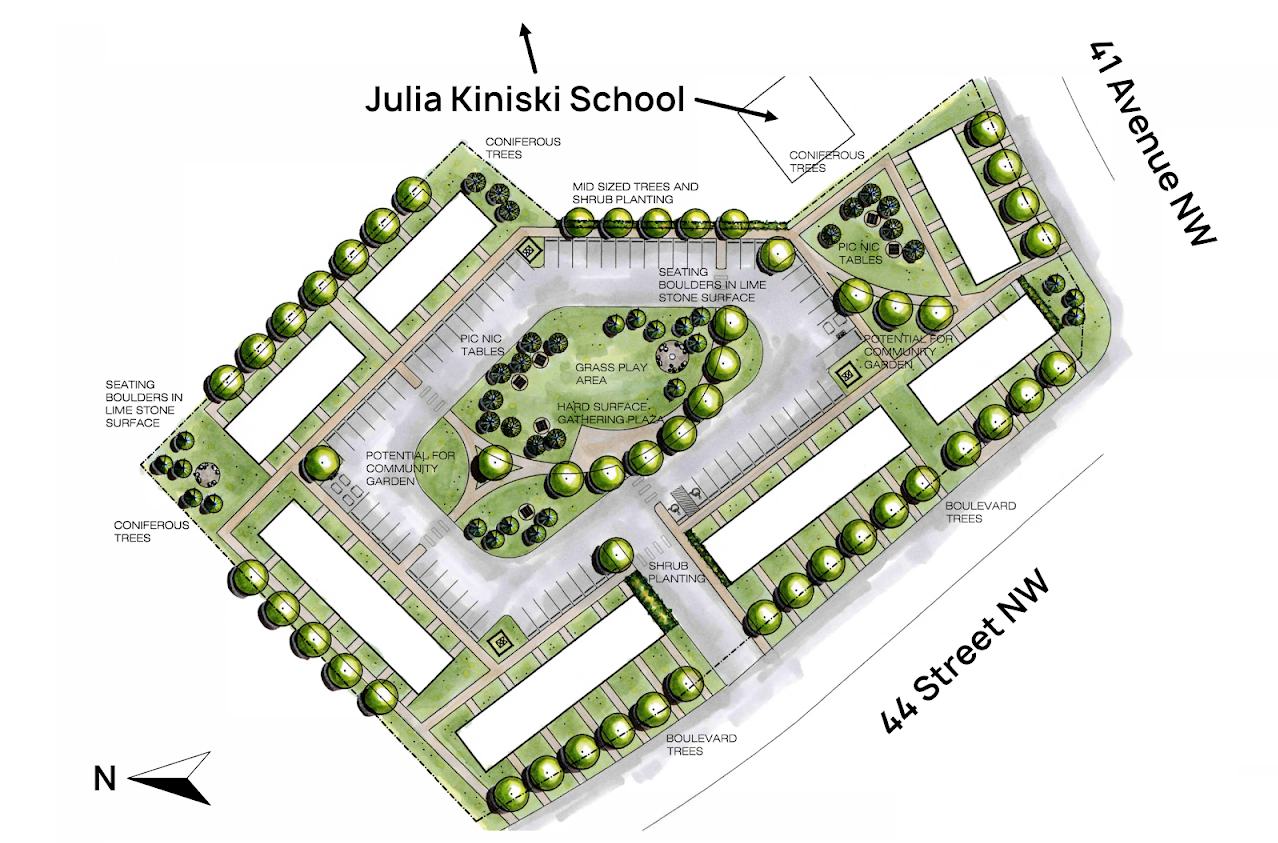
Kiniski Gardens: Right at Home Housing Society
La Perle: Beljan Development, San Rufo Homes and Art Homes
Lymburn: HomeEd
Miller: WIN House
Overlanders: Métis Capital Housing Corporation
Summerlea: Confederacy of Treaty No. 6 First Nations and Chiniki Group of Companies
Key Facts
The developments will provide approximately 1,300 new homes, including around 500 units with 3 or more bedrooms for larger families. About 70 per cent of the housing, or 925 units, will be on the affordable housing spectrum. Housing will be developed within the footprint originally intended for a school, leaving adjacent green space open.
To receive land or grant funding support from the City, affordable housing providers must provide housing at reduced rental rates as set out by the Maximum Allowable Rental Rates (MARR), which caps rent at 80 per cent of average market rates based on the CMHC's Annual Market Rental Reports.
One in eight households, one in four renter households and one in three Indigenous renter households are in core housing need, meaning they pay too much for housing or live in crowded or unsafe conditions and can’t afford to move.
For more information:
edmonton.ca/AffordableHousing

Media contact:
Hamdi Issawi
Senior Communications Advisor
Community Services

 
Tbh, I’d like to see a bit more high density around the LRT than just basement suites in every single new house.

Gentle density is great, but does make transit a further walk for more people and takes away from the vibrancy of clustered residential/commercial.
Most people I talk to about this stuff aren't anti-density - it's understood that this is part of the deal if you live in a central neighbourhood. In fact, the amenities that come with that density are why many of us choose to live in these neighbourhoods. I think your approach is the better one, and would quiet many of the problems people have around infill. Build denser around the LRT, and then scale down as you move into the interior of neighbourhoods. This doesn't mean that you have to go all the way to single-family homes. Most people don't mind a duplex, even with basement suites, but some of these projects are just ridiculous for their context.

I'm in Bonnie Doon, and the latest one I'm seeing go up is on the corner of 95th Street and 94th Ave, and it's this complex of two back-to-back giant structures with something like 16 units between them. It's architecturally ugly, and the units don't seem to be any bigger than what you would get in an apartment building. No yards, no amenities, just 16 households on top of one another where there used to be a duplex. 16 black carts, 16 green bins, 16 cars, all vying for parking on the one corner - I know the theory is that not everyone would need a car, but based on the other similar properties in the neighbourhood I am not sure that this is how this is playing out in reality.

Contrast this with the projects going up on the west side of 85th St across from the Holyrood LRT stop, the latest of which is a duplex + basement suites. This is where these larger projects should be going - not the 16-units like above, but actual, proper buildings with the benefits of scale. Maybe some mixed-use buildings or something. It's a total missed opportunity for actually enabling some people to live a car-free lifestyle if they so choose, while concentrating density to enable vibrancy. One place this does seem to be happening is on Rue Marie-Anne Gaboury/91 St, where it looks like they are actually putting up proper apartment building.

I am completely pro-density if done correctly. I live across from an older apartment building and have no problem with it at all. It's the new projects that are causing the issues, and making people who chose these areas for their vibrancy and amenities now resent the density that enables them. These older buildings with their practical layouts have largely held up over time. I have a hard time thinking there will be much demand to live in the 16-unit complex with its small units, impractical layout, and cheap finishes when they are 20 years old instead of brand new.
 

Screenshot 2025-11-24 183638.png


Screenshot 2025-11-24 184507.png


Screenshot 2025-11-24 184640.png


Screenshot 2025-11-24 184720.png
 
Last edited:
Affordable housing providers selected for 10 former surplus school sites
November 24, 2024

The City has selected affordable housing providers for 10 former surplus school sites, a major milestone in the effort to create more than 900 homes for Edmontonians in need.

“I am thrilled that we are one step closer to making this vision a reality. Too many Edmontonians are struggling to get by and can’t find the housing they need. Providing land to affordable housing providers is the best tool we have as a city to respond. These are not just new homes but new neighbours, better futures and stronger communities,” said Mayor Andrew Knack.

The 10 sites were reserved for schools for neighbourhoods built between the 1970s and 1990s. The sites were returned to the City in 2009 when they were no longer required by local school boards and in 2015, City Council designated them for affordable housing. With support from the federal government’s Housing Accelerator Fund, the City has dedicated resources to fulfill that vision.

“Every Edmontonian and Canadian deserves a place to call home. Our new government is catalyzing home building to make this a reality. Surplus school sites are one of the many tools in our toolbox to unlock the full potential of communities to build. This government is helping Edmonton build stronger, more inclusive communities,” said the Honourable Eleanor Olszewski, Minister of Emergency Management and Community Resilience and Minister responsible for Prairies Economic Development Canada.

"This is a strong example of partnership delivering real solutions. When we work together, we can turn good ideas into real homes for real people. These projects will mean stability, safety and opportunity for more than a thousand Edmonton families, and that's a win for the whole community," said the Honourable Jason Nixon, Minister of Assisted Living and Social Services and Minister responsible for Housing.

The housing providers were selected by the City through a competitive process that opened on National Housing Day in 2024. The selected projects offer housing across the affordable housing spectrum, from mixed-market housing (where some units are rented at below-market rates and subsidized by units rented at market rates) to deeply subsidized housing for very low-income individuals and families. Some projects are tailored to people who experience greater housing needs, including Indigenous people, Black Canadians, newcomers and women and children fleeing domestic violence. All the projects will offer affordable housing for a minimum of 40 years, the maximum term the City can secure under the Municipal Government Act.

The selected developers are:
Belmont: Civida, in partnership with Synergy Projects Ltd
Blue Quill: Bendera Housing
Caernarvon: Civida, in partnership with the Confederacy of Treaty No. 6 First Nations and Synergy Projects Ltd
Dunluce: Vivid Homes, in partnership with IslamicFamily
Kiniski Gardens: Right at Home Housing Society
La Perle: Beljan Development, San Rufo Homes and Art Homes
Lymburn: HomeEd
Miller: WIN House
Overlanders: Métis Capital Housing Corporation
Summerlea: Confederacy of Treaty No. 6 First Nations and Chiniki Group of Companies
Key Facts
The developments will provide approximately 1,300 new homes, including around 500 units with 3 or more bedrooms for larger families. About 70 per cent of the housing, or 925 units, will be on the affordable housing spectrum. Housing will be developed within the footprint originally intended for a school, leaving adjacent green space open.
To receive land or grant funding support from the City, affordable housing providers must provide housing at reduced rental rates as set out by the Maximum Allowable Rental Rates (MARR), which caps rent at 80 per cent of average market rates based on the CMHC's Annual Market Rental Reports.
One in eight households, one in four renter households and one in three Indigenous renter households are in core housing need, meaning they pay too much for housing or live in crowded or unsafe conditions and can’t afford to move.
For more information:
edmonton.ca/AffordableHousing

Media contact:
Hamdi Issawi
Senior Communications Advisor
Community Services
Ok, so these 10 major projects for HAF bucks PLUS whatever the $15M awarded to the unannounced list for DT projects? Should be a good omen that we are finally hearing about HAF projects - DT ones shouldn't be that far off!
 
Most people I talk to about this stuff aren't anti-density - it's understood that this is part of the deal if you live in a central neighbourhood. In fact, the amenities that come with that density are why many of us choose to live in these neighbourhoods. I think your approach is the better one, and would quiet many of the problems people have around infill. Build denser around the LRT, and then scale down as you move into the interior of neighbourhoods. This doesn't mean that you have to go all the way to single-family homes. Most people don't mind a duplex, even with basement suites, but some of these projects are just ridiculous for their context.

I'm in Bonnie Doon, and the latest one I'm seeing go up is on the corner of 95th Street and 94th Ave, and it's this complex of two back-to-back giant structures with something like 16 units between them. It's architecturally ugly, and the units don't seem to be any bigger than what you would get in an apartment building. No yards, no amenities, just 16 households on top of one another where there used to be a duplex. 16 black carts, 16 green bins, 16 cars, all vying for parking on the one corner - I know the theory is that not everyone would need a car, but based on the other similar properties in the neighbourhood I am not sure that this is how this is playing out in reality.

Contrast this with the projects going up on the west side of 85th St across from the Holyrood LRT stop, the latest of which is a duplex + basement suites. This is where these larger projects should be going - not the 16-units like above, but actual, proper buildings with the benefits of scale. Maybe some mixed-use buildings or something. It's a total missed opportunity for actually enabling some people to live a car-free lifestyle if they so choose, while concentrating density to enable vibrancy. One place this does seem to be happening is on Rue Marie-Anne Gaboury/91 St, where it looks like they are actually putting up proper apartment building.

I am completely pro-density if done correctly. I live across from an older apartment building and have no problem with it at all. It's the new projects that are causing the issues, and making people who chose these areas for their vibrancy and amenities now resent the density that enables them. These older buildings with their practical layouts have largely held up over time. I have a hard time thinking there will be much demand to live in the 16-unit complex with its small units, impractical layout, and cheap finishes when they are 20 years old instead of brand new.
I think 4 units mid block and 6-8 on corners (depending on lot) is good. Tons of density added that way. I also think 3rd floors should only be allowed with major setbacks and shouldn’t be the entire floorplate. Some of the 3 story 8plexes built midblock are so unnecessary. It’s all the downsides of an apartment with 20% of the housing units. Just build an apartment at that point. A smaller 3rd floor on a regular sized skinny or full lot is fine.

There’s only so much rental capacity and when we saturate it with hundreds of basement suites, it makes it less likely for us to get a 150 unit building with a commercial bottom and more urban street interface. That’s what we need more of for walkability and vibrancy. And apartments on top of LRT stops will drive more transit use than basement suites with free parking.
 
Developers clearly aren't building high density around transit anymore. If high density mid block infill is all they will offer, I will take it.
 
Developers clearly aren't building high density around transit anymore. If high density mid block infill is all they will offer, I will take it.
High density does not necessarily equal tall towers; you can still achieve relatively high densities in low/mid-rise given the shift towards a greater number of units being in the 400-700 sqft range.
 
High density does not necessarily equal tall towers; you can still achieve relatively high densities in low/mid-rise given the shift towards a greater number of units being in the 400-700 sqft range.
This seems to be what is slowly happening on 95 Ave in Strathearn near the LRT, and it's shaping up to be a great little street, especially when the Strathearn Heights redevelopment is finished. The perfect scale in the perfect location. Support this with smaller-scale infill (2/4 units) in the streets behind, and I think this could be a very vibrant little local area.
 
Developers clearly aren't building high density around transit anymore. If high density mid block infill is all they will offer, I will take it.
This is exactly why there were zoning rules before it seemed to have become a free for all, so more density would be built where it made sense (ie. around transit), not where it did not.
 
Noticed this update on the Infill Infrastructure Fund webpage:

Fund Status​

As of October 7, 2025, 17 projects have completed the application process and have had funds allocated.
  • $24M of $39M fund has been allocated to projects; $15M remains to be allocated
  • 2,642 housing units are in the 17 projects, including 220 non-market housing units across 5 projects
  • The average support is $9,100 per unit
  • Supported infrastructure includes:
    • Storm sewers
    • Sanitary sewers
    • Water mains and hydrants
    • 3-phase power upgrades
    • Sidewalk upgrades, crosswalks, bus stops, shared-use paths
    • Alley upgrades
    • Street lights
For more detailed project and fund allocation information, please see the 2025 Third Quarter Fund Status Update.

Could project 5 be the second tower for The Parks, and perhaps the connector building as well?
IIF.png
IIF1a.png
 

Back
Top