From the Edmonton Journal:
O-day’min Park: the heart of a renewed community
From parking lot to community park, O-day’min Park anchors the reinvention of this part of Edmonton.
Author of the article:
By
Laura Severs
Published Dec 12, 2025
Edmonton Evolves
Part 1: How starting with the development of a year-round park drives the thoughtful reinvention of a community.
Part 2: (coming next week) Inspiration other cities can take from Edmonton’s development playbook.
Parking lots dotting the centre of the city are disappearing — at least some of them.
In their place, just west of the downtown core, residential developments, including what some term the missing middle — low-rise apartments, in this instance slightly taller than the typical four or fewer storeys Canada Mortgage and Housing defines it as — are beginning to pop up as this part of Edmonton reinvents itself.
That land, on either side of 106th, 107th and 108th streets, just north of Jasper Avenue, is seeing a swath of surface parking lots transformed into much needed housing and more while also redefining how people will live in the city proper.
Today, in Part 1 of a two-part series, Postmedia looks at how this once-neglected area is changing. In Part 2, in next week’s Homes section, we talk to a former top city planner from eastern Canada who believes Edmonton is onto something and why he feels this way.
At least three developers have projects that are currently shovel ready, under construction or recently completed in the area surrounding the new O-day’min Park (formerly known as Warehouse Park).
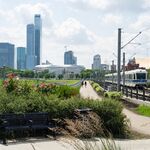
The park, which opened last month, sits on what used to be home to multiples of parking spaces. It is 1.81 hectares, or put another way, the size of 4½ NFL football fields. Designed for year-round use, it includes an off-leash dog park, a basketball court, an exercise area, a playground, a gathering space with fire pits and has a pavilion with washrooms and space to rent for community events — the pavilion won a 2024 Canadian Architect Award of Excellence. This is all highlighted by a Northern Lights feature, a 200-metre long raised, circular-like lighting installation designed to reflect the magic of the aurora borealis.
The park, said Ian O’Donnell, is the real driver of the development the area is now seeing.
“When you’re looking at development, it’s about partnerships,” said O’Donnell, development manager at Westrich Pacific, which has three residential developments in play here, all adjacent or near the park. “The public investment of close to $50 million into the new O-day’min Park convinced us in the development industry that we need to come along and be a partner in the area. So that initial investment is going to lead to hundreds of millions of dollars in public investment around the park.”
Westrich’s three projects, Lotus Park, Lilac Park, and a yet to be named third residential building that just received the go-ahead, will bring some 600 residential rental units and about 750 new residents to this part of the city.
Lotus Park, at six storeys, will have 152 units but will not include parking aside from bicycle parking. This, said O’Donnell, allows Westrich to provide a more affordable urban living option and take advantage of its location: close to the downtown core, near the educational facilities of Norquest College and MacEwan University and near the new under construction LRT line.
“One of the high costs of development is providing parking and so this will be bit of a unique test case where residents will be able to have a more affordable rental unit,” said O’Donnell, who added that those who need parking will have access to it in a neighbouring building.
Just south of Lotus Park, which saw construction start earlier this year and should be completed by mid-2026, is Lilac Park. Lilac will be seven storeys, with 239 units and will have underground parking. Construction should start in the first quarter of 2026. Both buildings will have studios, one-, two- and three-bedroom units, gyms, and rooftop patios and barbecues, while Lilac will have a wellness spa as well as underground parking. Construction on Lilac is expected shortly. The third building, also to occupy the space of a surface parking lot, will have 201 units, and two levels of underground parking and will feature studio, one-, two- and three-bedroom apartments. It will be seven storeys and also include a wellness spa, gym and rooftop patio.
“Our focus is making our buildings highly interactive with a diversity of social space for residents,” said O’Donnell.
This third Westrich project is right next to another residential development waiting to break ground on another surface parking lot, this one from Autograph Group, the developer of the Mercury Block and other residential projects just off 124th Street and 102nd Avenue.
It was once going to be The Shift, two towers — one of 37 storeys, the other of 35; with 730 luxury rental apartments — atop a four-storey podium. But that was pre-COVID and the market shifted. Autograph has since had the land rezoned and is now looking at one building similar in size and scale to the Mercury Block, which is seven storeys, has 163 rental units with a courtyard surrounded by retail on the main level.
Then there’s the Parks from Maclab Development Group. Also right next to the park, and on the site of the former El Mirador apartments — known for its Spanish-like architecture — the 37-storey building has 363 rental suites with a mix of studios, one-, two- and three-bedroom rentals. This is Phase 1 and is more than 40 per cent leased; the first tenant moved in this past March. Phase 2, dependent on how Phase 1 does, would include a podium connecting to a 45-storey tower.
“(It’s about) investing in the area and believing in it becoming the next residential hub,” said O’Donnell, adding that there’s half a dozen developers looking at moving forward projects in this area.
The City of Edmonton expects that by November 2026 there will be a total of 1,604 residential units either completed or under construction in the immediate area of O-day’min Park.