|
|
|





You are using an out of date browser. It may not display this or other websites correctly.
You should upgrade or use an alternative browser.
You should upgrade or use an alternative browser.
Edmonton International Airport (EIA/YEG)
- Thread starter Daveography
- Start date
husky
Active Member
Sounds like UA is ending YEG-ORD next year
blue12
Active Member
UA filed that change 2 months ago at the start of September.Sounds like UA is ending YEG-ORD next year
From my earlier post:
United has dropped ORD in return for going daily on IAH for 2026, as opposed to the 3x weekly ORD and 4x weekly IAH this past summer.
Not all that shocking given their YEG-ORD was a pretty last-minute response to Westjet's same route and the initial plan was to in fact do just daily IAH.
DEN is scheduled to remain at 2x daily.
MacLac
Senior Member
I think we already knew that United was extending Houston to Daily year round, hence why we're losing the 3 X weekly to ORD. WJ may or may not still offer 3 weekly next Summer.....we'll see.
Last edited:
husky
Active Member
My bad! Missed it.UA filed that change 2 months ago at the start of September.
From my earlier post:

IanO
Superstar
Edmonton International Airport (YEG)
Sixty-five years ago today, on November 15, 1960, our very first flight took off from Edmonton International Airport — a moment that marked the beginning of countless journeys, reunions, and adventures. Back then, travel was simpler, slower and filled with a sense of wonder.
Over the decades, we’ve witnessed the evolution of aviation: from propellers to jets, paper tickets to mobile boarding passes and the rise of sustainable innovation that’s shaping the future of air travel.
Through it all, one thing has remained constant: our commitment to connecting people, places and possibilities. Every takeoff and landing still carries that same excitement, that same promise of what lies ahead.
Here’s to 65 years of flight, and to the next chapter of connection, growth and community.
---
By an unwritten “gentleman’s agreement,” the original landowners were allowed to lease back and continue to farm until the land was needed for the airport.
Turning farmland into runways was not easy:
In 1963, our 370,000 square foot steel and glass terminal that is now YEG’s north terminal opened. It cost $10 million and was ready a year ahead of schedule.
The airport served growing numbers of passengers over the next 20 years:
The two-airport system had challenges:
Consolidation put new pressures on YEG. The main terminal was designed to accommodate 2.5 million passengers per year, but by 1999, 3.8 million passengers were using YEG annually.
A new south terminal was built to house Air Canada and international carriers. WestJet became the principal tenant of the north terminal.
Central Hall was built to accommodate security screening and retail services. A new cargo apron was built to handle growing volumes of shipments by air.
By 2007, YEG was handling over 6 million passengers per year, flying to 53 non-stop destinations in Canada, the United States, Mexico, the Caribbean and Europe.
In 2012, another $700 million was invested on additional gates, a new passenger concourse and expanded parking.
We are Canada’s largest airport in area – with more than half of our available land still under cultivation in 2018.


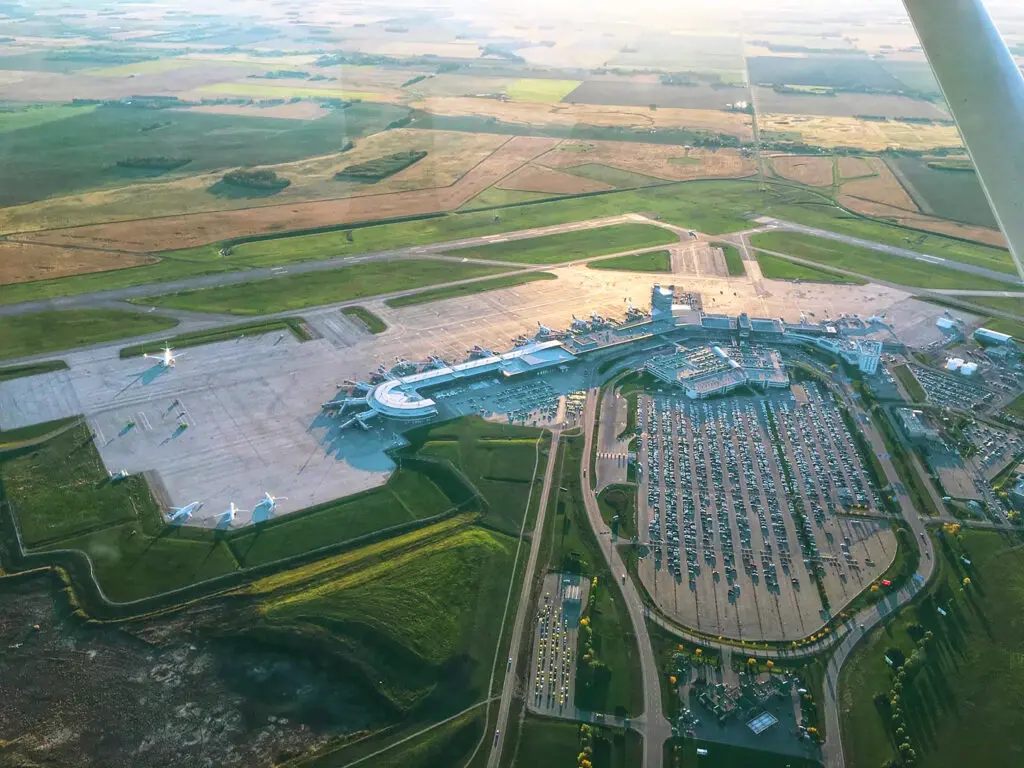
Sixty-five years ago today, on November 15, 1960, our very first flight took off from Edmonton International Airport — a moment that marked the beginning of countless journeys, reunions, and adventures. Back then, travel was simpler, slower and filled with a sense of wonder.
Over the decades, we’ve witnessed the evolution of aviation: from propellers to jets, paper tickets to mobile boarding passes and the rise of sustainable innovation that’s shaping the future of air travel.
Through it all, one thing has remained constant: our commitment to connecting people, places and possibilities. Every takeoff and landing still carries that same excitement, that same promise of what lies ahead.
Here’s to 65 years of flight, and to the next chapter of connection, growth and community.
---
From farmland to flights (1955)
In 1955, land near Leduc was chosen as the future site of the Edmonton International Airport. Transport Canada purchased 7,600 acres of land for $1,469,657.By an unwritten “gentleman’s agreement,” the original landowners were allowed to lease back and continue to farm until the land was needed for the airport.
Turning farmland into runways was not easy:
- Weeds overtook the construction area and polluted the surrounding farmland
- A colony of beavers outwitted many human attempts to prevent them from flooding the site
- Airport security in those days meant keeping livestock off the runways
The first flight (1960)
On November 15, 1960, Edmonton International Airport opened for passenger service using the L-3 Communications Spar Aviation hangar as a temporary terminal.In 1963, our 370,000 square foot steel and glass terminal that is now YEG’s north terminal opened. It cost $10 million and was ready a year ahead of schedule.
The airport served growing numbers of passengers over the next 20 years:
- 1962: 394,000 passengers
- 1974: 1.1 million passengers
- 1980: 2 million passengers
Growing pains (1970s-1990s)
During the 1970s and 1980s, YEG handled wide-body jets that carried up to 400 passengers non-stop to Europe. The Edmonton Municipal Airport became a hub for short-haul flights, a convenience for business travellers.The two-airport system had challenges:
- Connecting passengers had to travel between two airports
- Passenger volumes at YEG declined between 1983 and 1995
- There were fewer non-stop flights from YEG, requiring passengers to connect through Calgary or Vancouver
- Passenger growth at the Municipal Airport created more aircraft noise for city residents
Consolidation put new pressures on YEG. The main terminal was designed to accommodate 2.5 million passengers per year, but by 1999, 3.8 million passengers were using YEG annually.
YEG grows (2000s-2010s)…
In the late 1990s and early 2000s, YEG underwent a major construction program that cost $450 million.A new south terminal was built to house Air Canada and international carriers. WestJet became the principal tenant of the north terminal.
Central Hall was built to accommodate security screening and retail services. A new cargo apron was built to handle growing volumes of shipments by air.
By 2007, YEG was handling over 6 million passengers per year, flying to 53 non-stop destinations in Canada, the United States, Mexico, the Caribbean and Europe.
In 2012, another $700 million was invested on additional gates, a new passenger concourse and expanded parking.
…and grows (2015-2020s)
YEG is one of the fastest growing airports in Canada. We continue to invest in technology and development to serve more passengers and businesses in more ways.- Airport City – with a large variety of businesses and tenants onsite, Airport City is bringing renewed growth, tourism and economic development to the region
- Cargo Village – we are investing in our Cargo Village infrastructure and partnerships to meet the growing and changing demand for cargo services
We are Canada’s largest airport in area – with more than half of our available land still under cultivation in 2018.

Vanfan123
Active Member
I think we already knew that United was extending Houston to Daily year round, hence why we're losing the 3 X weekly to ORD. WJ may or may not still offer 3 weekly next Summer.....we'll see.
Currently on Google Flights Search is showing end of June to early to early October 2026, WestJet Edmonton YEG - Chicago ORD- YEG route operates 2x weekly- Thursdays & Saturdays.
blue12
Active Member
An updated route map on Westjet's website yesterday displayed 8 new destinations, 2 of which were from Edmonton - Glasgow and Reykjavik.
They have since been removed from the map, but hopefully this is a tease of what is to come and not a glitch. YEG-KEF is long overdue to return and YEG-GLA is a great addition.
The other routes were YYZ-MDE/PDL/CWL, YWG-KEF/GLA, and YHZ-MAD/LIS/CPH for those curious.
They have since been removed from the map, but hopefully this is a tease of what is to come and not a glitch. YEG-KEF is long overdue to return and YEG-GLA is a great addition.
The other routes were YYZ-MDE/PDL/CWL, YWG-KEF/GLA, and YHZ-MAD/LIS/CPH for those curious.
Oilguy
Active Member
That would be awesome, but does Westjet even have the fleet for that right now?An updated route map on Westjet's website yesterday displayed 8 new destinations, 2 of which were from Edmonton - Glasgow and Reykjavik.
They have since been removed from the map, but hopefully this is a tease of what is to come and not a glitch. YEG-KEF is long overdue to return and YEG-GLA is a great addition.
The other routes were YYZ-MDE/PDL/CWL, YWG-KEF/GLA, and YHZ-MAD/LIS/CPH for those curious.
blue12
Active Member
They do. Both would be 737 MAX 8 routes which they've got enough of, especially amidst the reductions on American routes. GLA would be cutting it real close on the 737 and would likely have to operate on a slightly reduced load, but it is possible.That would be awesome, but does Westjet even have the fleet for that right now?
Glenco
Senior Member
How about YEG-KEF-GLA.They do. Both would be 737 MAX 8 routes which they've got enough of, especially amidst the reductions on American routes. GLA would be cutting it real close on the 737 and would likely have to operate on a slightly reduced load, but it is possible.
Oilguy
Active Member
Yeah I’d think edm to glasgow would be a tight stretch was thinking that would need to be a 787 route,They do. Both would be 737 MAX 8 routes which they've got enough of, especially amidst the reductions on American routes. GLA would be cutting it real close on the 737 and would likely have to operate on a slightly reduced load, but it is possible.
blue12
Active Member
It's feasible on the 737, yes more feasible on the 787 but that's much less likely. Allocating a 787 to do YEG-GLA would require frequency reductions on another 787 route which I don't foresee happening. Same goes for YWG-GLA.Yeah I’d think edm to glasgow would be a tight stretch was thinking that would need to be a 787 route,

Windermere
Active Member
WestJet summer schedule will be announced on Tuesday.
Oilguy
Active Member
Very close. 3500 miles from here to there and range is 3900. Then you have to count on etops for the crossing and I’m not sure what the rules are for that. Doable, but tight.It's feasible on the 737, yes more feasible on the 787 but that's much less likely. Allocating a 787 to do YEG-GLA would require frequency reductions on another 787 route which I don't foresee happening. Same goes for YWG-GLA.