News   Apr 03, 2020
 9.8K     3 
News   Apr 02, 2020
 11K     0 
News   Apr 02, 2020
 3.8K     0 

Cycling and Active Transportation in Edmonton

Can someone run the numbers for me on that? Quick and dirty I see 100 mil/ 4 years = (25 mil/yr)/~1mil ppl = $25/person/year?

I think it's important to be careful with the wording around this stuff as it is an option that many folks don't even have be it due to disability and many other valid reasons. Having a solid and safe bike network will certainly induce demand which is great for so many reasons, I just hesitate to get into arguments around using numbers as a justification as I don't think that is a winning argument in the end (but happy to be proven wrong).
Personally it could be 100 million, 200 million, and so on, I’m just happy it’s getting investment. As for Janz’s numbers, I imagine it takes into account that not all city revenue is property taxes, and not all property taxes are residential so the explicit amount each individual pays for it through taxes wouldn’t be 25 per year. (If I’m completely off on this please let me know cause taxes aren’t my area of knowledge)
 
Can someone run the numbers for me on that? Quick and dirty I see 100 mil/ 4 years = (25 mil/yr)/~1mil ppl = $25/person/year?

I think it's important to be careful with the wording around this stuff as it is an option that many folks don't even have be it due to disability and many other valid reasons. Having a solid and safe bike network will certainly induce demand which is great for so many reasons, I just hesitate to get into arguments around using numbers as a justification as I don't think that is a winning argument in the end (but happy to be proven wrong).

Many of the city's capital projects are through debt servicing. Like most, this project will not be paid off by 2026 so can't use 4 years in calculations - similar to Lewis Estates rec centre and many more.
 
Last edited:
Can someone run the numbers for me on that? Quick and dirty I see 100 mil/ 4 years = (25 mil/yr)/~1mil ppl = $25/person/year?

I think it's important to be careful with the wording around this stuff as it is an option that many folks don't even have be it due to disability and many other valid reasons. Having a solid and safe bike network will certainly induce demand which is great for so many reasons, I just hesitate to get into arguments around using numbers as a justification as I don't think that is a winning argument in the end (but happy to be proven wrong).
This is a really classic arguement that’s really frustrating tbh. A significant number of people also can’t drive due to disabilities…and old age…and cause their youths. Yet we rarely hear people critique car dependent infrastructure this way. We can’t choose to become accessibility advocates when people are suggesting a 100kms of bike lanes to be added to a transportation system with 11,000kms of roads. Same way everyone suddenly caring a lot about homelessness when the bike plan is discussed is sort of sus because no one seemed to care when we dropped 2bil on yellowhead, terwillegar, 50st and 23ave to essentially move cars a few mins quicker.
 
This is a really classic arguement that’s really frustrating tbh. A significant number of people also can’t drive due to disabilities…and old age…and cause their youths. Yet we rarely hear people critique car dependent infrastructure this way. We can’t choose to become accessibility advocates when people are suggesting a 100kms of bike lanes to be added to a transportation system with 11,000kms of roads. Same way everyone suddenly caring a lot about homelessness when the bike plan is discussed is sort of sus because no one seemed to care when we dropped 2bil on yellowhead, terwillegar, 50st and 23ave to essentially move cars a few mins quicker.

Great point, and just for reference (this from Coun. Hamilton on Ryan Jespersen show today)
The 2023-26 budget contains $21.6 billion in capital and operational spending including:
$4 000 000 000 for roads
$2 000 000 000 for transit
$100 million for bike infra (not including bike lane maintenance) which is 1.64% of our total spending on transportation and moving people around

Which one of those budget line items are taking away spending on homelessness? Oh right, it's the bike spending.
 
Last edited:
Great point, and just for reference (this from Coun. Hamilton on Ryan Jespersen show today)
The 2023-26 budget contains $21.6 billion in capital and operational spending including:
$4 000 000 000 for roads
$2 000 000 000 for transit
$100 million for bike infra (not including bike lane maintenance) which is 1.64% of our total spending on transportation and moving people around

Which one of those budget line items are taking away spending on homelessness? Oh right, it's the bike spending.
And our spending on housing, addictions, policing, security, downtown, shelters, etc is actually huge. People don’t realize there are hundreds of millions going into this already. Not to mention that a lot of it is provincial responsibility.
 

Update: December 19, 2022

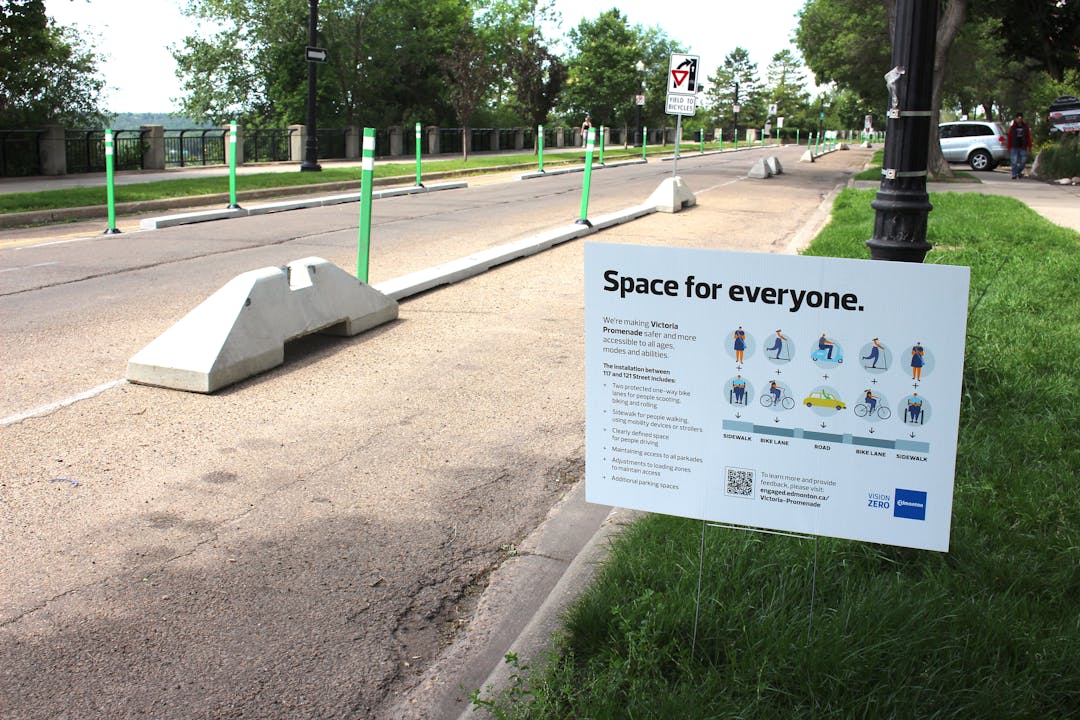
As soon as the weather and extreme temperatures permit, adjustments will be made to the Victoria Promenade Pilot Project. The timing of this will be driven by temperatures and ensuring that working conditions are safe for our staff (ie. City crews cannot safely perform the work in temperatures lower than -25 degrees).

We have seen a positive impact on speeding, shortcutting and cyclist behaviours as a result of this project. The installation, however, did not meet the needs of a cross-section of community members and highlighted opportunities for improvements. We are committed to listening and learning, and we want to thank Edmontonians who have shared their experiences with the Victoria Promenade pilot project.

The fall engagement report summarizing the results of the public engagement and the technical analysis is now available here(External link).

Planned Adjustments:

  • We will begin removing the north side bike lane along the Victoria Promenade from 100 Avenue and 117 Street to south of the intersection of 100 Avenue and 121 Street.
  • The speed limit along Victoria Promenade will be lowered to 30 km/h.
  • 19 of the 20 original loading and parking spots will be re-installed on 100 Avenue.
    • The loading zone in front of the Mayflower building will be re-installed on 100 Avenue, so the loading zones on the side street near the Mayflower building will return to their original two 2 hour parking stalls.
  • The bike lane on the south side of the street, as well as the traffic calming on 100 Avenue east of 117 Street and between 116 and 117 Street, will remain in place.
Once the adjustments are complete:

  • People driving and cycling west will use the street in a single file until the intersection of 121 Street and Jasper Avenue. Cyclists will then move into a protected bike lane to allow for a safer transition through the intersection.
  • People cycling east will continue to use the protected bike lane on the south side of the Victoria Promenade.
Snow and Ice Clearing:

  • As you may have noticed, snow does accumulate around and on top of the adaptable traffic measures on the street. This is expected and not unsafe.
  • Snow and ice is maintained as part of the standard Snow and Ice operations prioritization schedule, which can be found at edmonton.ca/SafeTravels(External link).
If any issues are experienced with the remaining adaptable traffic measures, residents are encouraged to contact 311 for the most efficient response.
 
Bout time. What an idiotic waste of money and resources when commonsense could have prevailed.

I am ALL for bike lanes where and when they make sense, but this transformation was embarrassing on so many fronts.

What I want to know is IF Anne drove this and WHO at admin (or otherwise) supported it without reasonableness.

Newfangled must be rollin' - what a sad day.
 
Last edited:
I would argue the removal is the complete waste of money. So is the long-term plan to move both cycling lanes to the south side of the Promenade? Now that accelerated Bike Plan implementation is funded, I highly doubt the Promenade will return to the status quo for long.
 
This was surely shared last year but I found it trying to gather some literature on what to expect in Edmonton with this funding.


Building a bunch of lanes is no silver bullet and some of the biggest challenges even with new lanes I see are:

  • People need a simple, safe, and secure way to store their bikes at their destination
  • Habits are very engrained so people need to be really taught about new route connections and they will have to be easy to navigate
  • Winter cities can have a bike culture but bike lane clearing as the network grows will continue to be important and convincing people to bike in the winter is a habit/culture change that could be the biggest lift.
 
I would argue the removal is the complete waste of money. So is the long-term plan to move both cycling lanes to the south side of the Promenade? Now that accelerated Bike Plan implementation is funded, I highly doubt the Promenade will return to the status quo for long.
Here’s what’s insane:

-east of 110st is a bi-directional bike lane on the north side of 100ave.
-north of jasper ave is a painted uni-directional bike lane on both the east and west sides of 121st.

I was in the engagement and the key reason for uni-directional on Victoria was because of 121 becoming 2 seperate lanes. Even though it’s crappy painted lanes in a door zone that needs to be redone anyways.

What we should actually do is just bi-directional along one side of Victoria and then change 121st to bidirectional as well since it’s not permanent yet.

Why we based a whole pilot on a bad design elsewhere that’s not even staying likely is beyond me. And we would have avoided all the parking stuff and pissed off newspaper letters AND got the bike lane design most bikers wanted.

How the city ensured both camps were pissed is beyond me tbh.
 
This was surely shared last year but I found it trying to gather some literature on what to expect in Edmonton with this funding.


Building a bunch of lanes is no silver bullet and some of the biggest challenges even with new lanes I see are:

  • People need a simple, safe, and secure way to store their bikes at their destination
  • Habits are very engrained so people need to be really taught about new route connections and they will have to be easy to navigate
  • Winter cities can have a bike culture but bike lane clearing as the network grows will continue to be important and convincing people to bike in the winter is a habit/culture change that could be the biggest lift.
Safe storage will be key for us. Especially at transit stations. And we should do subsidies for turning in old cars like many European countries do. Scrap an old car and get 3k credit for ebike. Helps people think twice at a moment of decision/change. Vs trying to get people to randomly deciding in the middle of a car ownership cycle. When they’re looking at 10-40k for a new car, a 3k ebike is enticing.

also, we need major work done around high school and universities. Delaying car ownership is key. Many Edmontonians will have to have access to 1 car for a season of life (families especially). But the less households with people in the 16-25 age range owning 1 car per person the better!

And then moving as many households to 1 car plus bikes/transit is key. So many homes have 2-4cars for 2-4 people.
 
And then moving as many households to 1 car plus bikes/transit is key. So many homes have 2-4cars for 2-4 people.

I think the city manager said there are about 715,000 vehicles registered in Edmonton so factoring out all the people who can't drive or can't afford to drive or who choose not to drive, that's a pretty high number.

About 500,000 Edmontonians have bikes, too, so that bodes well for the upcoming infrastructure.
 
I think the city manager said there are about 715,000 vehicles registered in Edmonton so factoring out all the people who can't drive or can't afford to drive or who choose not to drive, that's a pretty high number.

About 500,000 Edmontonians have bikes, too, so that bodes well for the upcoming infrastructure.
Totally. We need better data on transportation in our city. Multi modal is the future. Most data we collect is commuter based and assumes the most used method is the only method.

In reality, the future for many could look like:
-walk with kid to school.
-LRT to work.
-bike share to drinks in evening
-drive kids to hockey in evening (car share or owned).

And we’ll see big seasonal swings with transit and biking for winter & school seasons. Many will rarely drive in the summers in the future, but will keep cars for winter.

We need to better measure this. It’s not about getting car drivers to become cyclists or something. But increasing the number of trips in non car modes in a typical week/month.
 

Back
Top